Capitals or Lowercase? How to Write a Name on a Tracing Sheet
The short answer: practise it the way it will always be written — Mia, first letter capital, the rest in lowercase. Save ALL CAPS for the very first attempts (or for matching a school that asks for it), then switch as soon as small letters stop feeling wobbly.
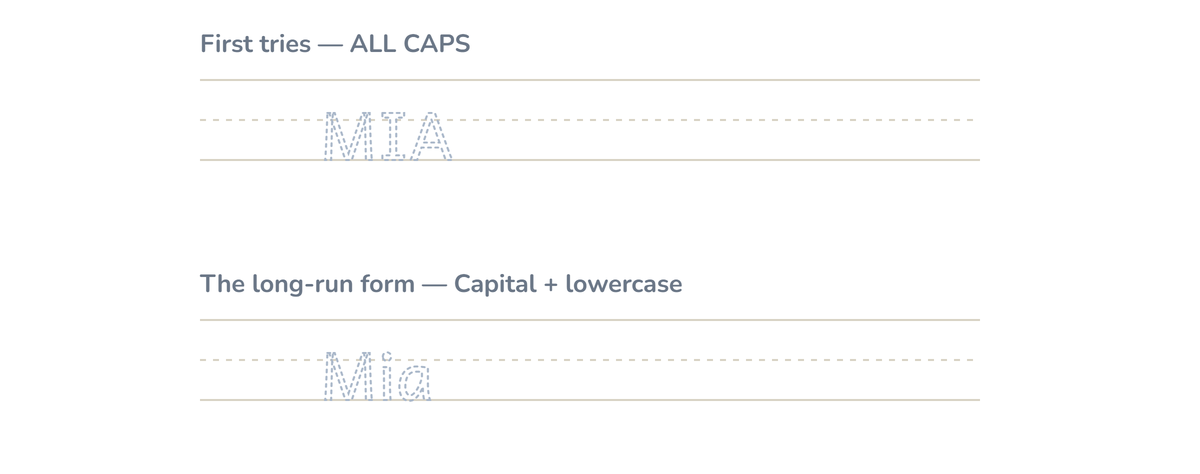
Both are names — but only one is how the name will look everywhere else.
Why first-letter-capital is the long-term target
A name is usually the first word a child learns to read, and everywhere they see it — books, name tags, cubbies, birthday cards — it appears as Mia, not MIA. Practising the printed form means reading and writing reinforce each other instead of teaching two different habits.
Lowercase also carries the shapes that make up almost everything else they will ever write — a, e, g, y — so time spent on small letters now is never wasted. Starting in all caps means coming back to learn the same letters a second time, in a second form.
When ALL CAPS earns its place
Block capitals still have a job: they are almost all straight strokes and exactly the same height, which makes them the friendliest target for the very first tries — usually around age three, sometimes earlier — while pencil grip is still settling.
- Use it as a ramp, not a destination. A few weeks of an all-caps name can build the confidence to attempt taller and smaller letters.
- Switch when it stops being useful. Once your child can hold the pencil steadily and letters keep their heights, move to capital + lowercase. Many families make the swap within a month or two — there is no deadline.
- If preschool asks for a certain form, match it. A few weeks of doing it the school's way beats any general rule — and consistency between home and classroom is worth more than either style on its own.
Setting up the sheet (in about ten seconds)
- Type the name the way you want it practised. The sheet prints exactly what you type — type MIA for an all-caps scaffold, or Mia for the form the child will use for life.
- Leave Letter style on “Dotted trace” — the follow-the-outline stage.
- Pick a size. Preschool for a three- or four-year-old; drop to Kindergarten when the letters start feeling easy.
- Set Trace rows to 2 or 3. The lines underneath stay blank — that is where the real practising happens.
- Print it (or choose “Save as PDF” to keep a copy).
When tracing the dotted name feels automatic, switch Letter style to “Solid trace” — light gray letters, same name — and let the blank rows be the honest test. Most children move through trace → trace gray → write alone in that order:
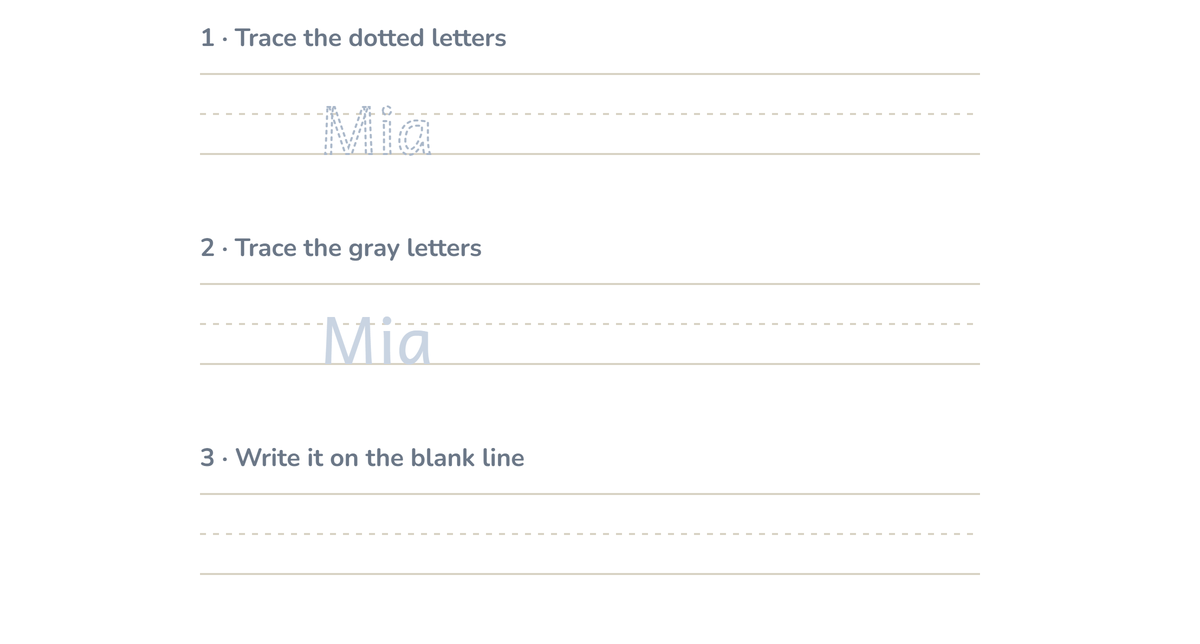
The usual path: trace the dots, then the gray letters, then all on their own.
How often should they practise?
A few minutes most days beats one long session on the weekend. One printed sheet per sitting is plenty — stop when the last row still looks fresh, and stop earlier if a row starts going backwards. Short and happy is the whole trick.
Long names and accents
Quick answer: drop one letter size and use two trace rows so a longer name still fits on one line — and hyphens, apostrophes and accented letters (é, ñ, ü) all print correctly on the sheet.
Quick answers
Should we practise the last name too?
Not at first. Start with the first name on its own; add the last name once the first feels easy — most children add it happily by kindergarten.
Our preschool writes names in ALL CAPS — should we match?
Yes, while they are in that class. The generator follows whatever you type, so switch between styles in one click — there is nothing to reconfigure.
When can they stop tracing?
When they can write the name from memory on a blank row without hesitating. Keep the tracing sheets for the letters that wobble — they usually fix themselves with a few more goes.
Try it right now
Type a name into the name tracing generator and print a sheet — or see the preschool worksheets, the printable worksheets page, and all the free name tracing options.